There is a quiet shift happening with small businesses and AI: the first wave was about getting access to powerful models. The next wave is about controlling the cost of using them every day.
The Token Meter Changes The Conversation
For many small and mid-sized businesses, AI started with a subscription: ChatGPT, Claude, Copilot, Gemini, or another cloud tool. That is still the fastest way to get started, and it is still where the most capable frontier reasoning lives.
But once AI moves from experimentation into operations, the economics change.
Every summary, rewrite, classification, product description, support response, internal report, automation test, retrieval query, and coding iteration becomes a token event. At low volume, that is fine. At business volume, especially when you start automating workflows, the token meter becomes part of your operating model.
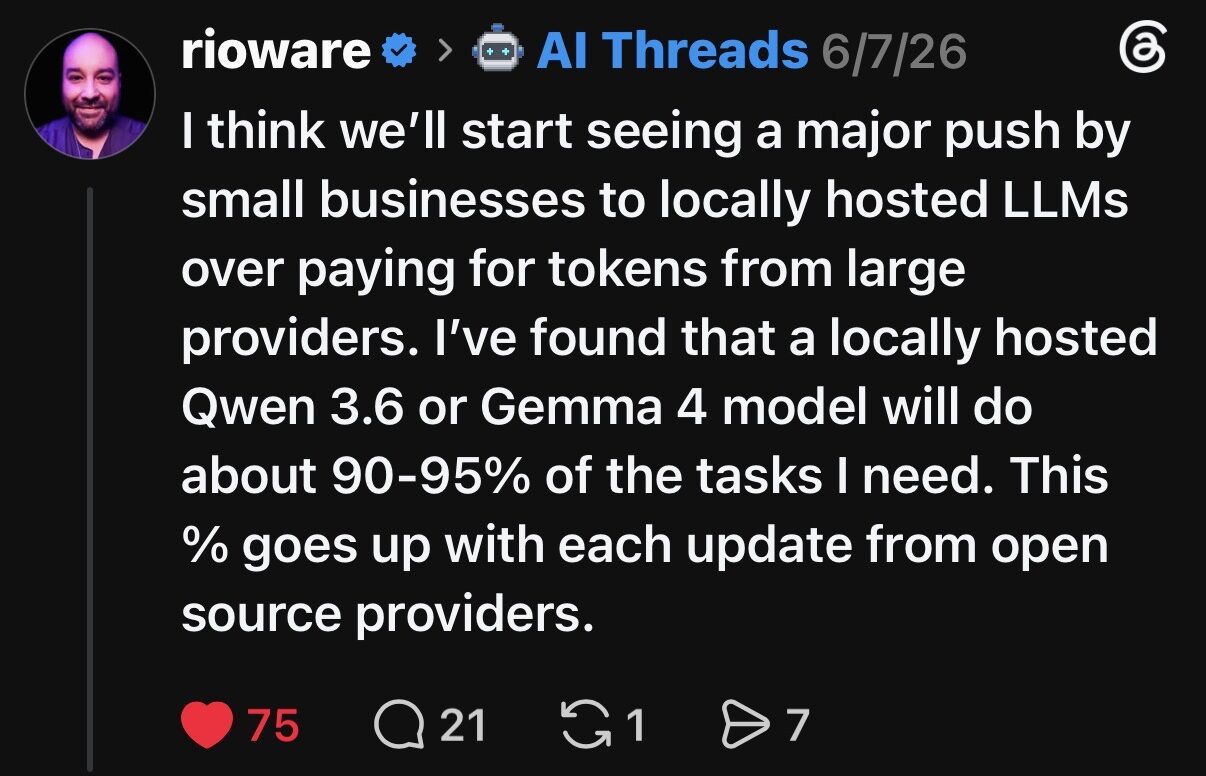
That is why I am seeing more small business owners become interested in open source and open-weight AI models running on local or consumer-grade hardware. This is not because they are trying to avoid frontier AI entirely. It is because they want to stop sending every repeated task through the most expensive layer of the stack.

What I Am Seeing With Business Owners
I have personally spoken with business owners who are moving in this direction. In each case, the pattern was similar:
- They saw the value of AI quickly.
- They wanted to use it more often across their business.
- They became concerned about recurring token costs, privacy, or vendor dependence.
- They did not need a frontier model for every workflow.
My recommendation to each of them was not “cancel closed models.” It was to build a hybrid AI stack:
Use open source models for repeatable, private, high-volume work. Use frontier models for complex reasoning, coding architecture, workflow design, and high-value synthesis.
That distinction matters. The winning strategy for most SMBs is not local versus cloud. It is routing the right task to the right model.
The Practical SMB AI Stack
A realistic small business AI stack now looks something like this:
| Workload | Best Fit | Why |
|---|---|---|
| Daily summaries, logs, notes | Local open model | Repeatable and high-volume |
| Classification and routing | Local open model | Structured, predictable, inexpensive once running |
| Internal knowledge search | Local model + local retrieval | Better data control |
| First-draft content | Local or hybrid | Good enough for rough drafts and variants |
| Complex coding architecture | Frontier model / OpenAI Codex | Higher reasoning quality changes the outcome |
| Reusable scripts and workflows | Frontier-designed, local-repeated | Use the expensive model once to design the process, then repeat cheaply |
| Executive decisions and public strategy | Frontier model + human review | Nuance, synthesis, and judgment matter |
The Frontier-To-Local Workflow Pattern
The most important pattern I have been helping people understand is this:
- Use a frontier model to solve the hard version of the problem.
- Turn that solution into a defined process, checklist, script, prompt, or workflow.
- Move the repeated execution of that process to a local open source model.
This is where tools like OpenAI Codex still matter. A stronger frontier model is often worth it when you are designing the workflow, building the automation, debugging the implementation, or establishing the process for the first time.
But after that process exists, many of the repeated steps do not need the same premium model every time. A local model can often run the routine version: classify the input, fill the template, check the result, summarize the output, or execute a known workflow.
In other words:
Use the frontier model to build the machine. Use the open model to run the machine.
Our Own Usage Supports This

We have been testing this pattern directly in our own AI infrastructure. Our internal ORBIT and Hermes usage logs show more than 1 billion tracked tokens across over 6,500 sessions. The overwhelming majority of that volume has gone through Qwen-family local/open model workflows, while GPT-5.5 via OpenAI Codex is used much more selectively for high-complexity reasoning, architecture, coding, and public-facing synthesis.
That is exactly the point. The expensive model is still valuable. It is just not the default for every operation.
In our model benchmarking, open models such as Qwen 3.6 and Gemma 4 have been strong enough for a large percentage of practical non-coding work:
- Data analysis and summarization: roughly 95% of the practical value of frontier models for many common tasks.
- Research and Q&A: roughly 85% parity in our workflow testing.
- Complex multi-step automation: closer to 75–80%, where frontier models still have a meaningful edge.
Those numbers should not be read as “open models are always equal.” They are not. The gap still compounds on harder tasks. But for everyday business operations, “good enough, private, repeatable, and cheap to run” is a very powerful combination.
Consumer Hardware Is Becoming Enough
The other reason this shift matters is hardware. You no longer need a massive enterprise cluster to get practical value from local models.
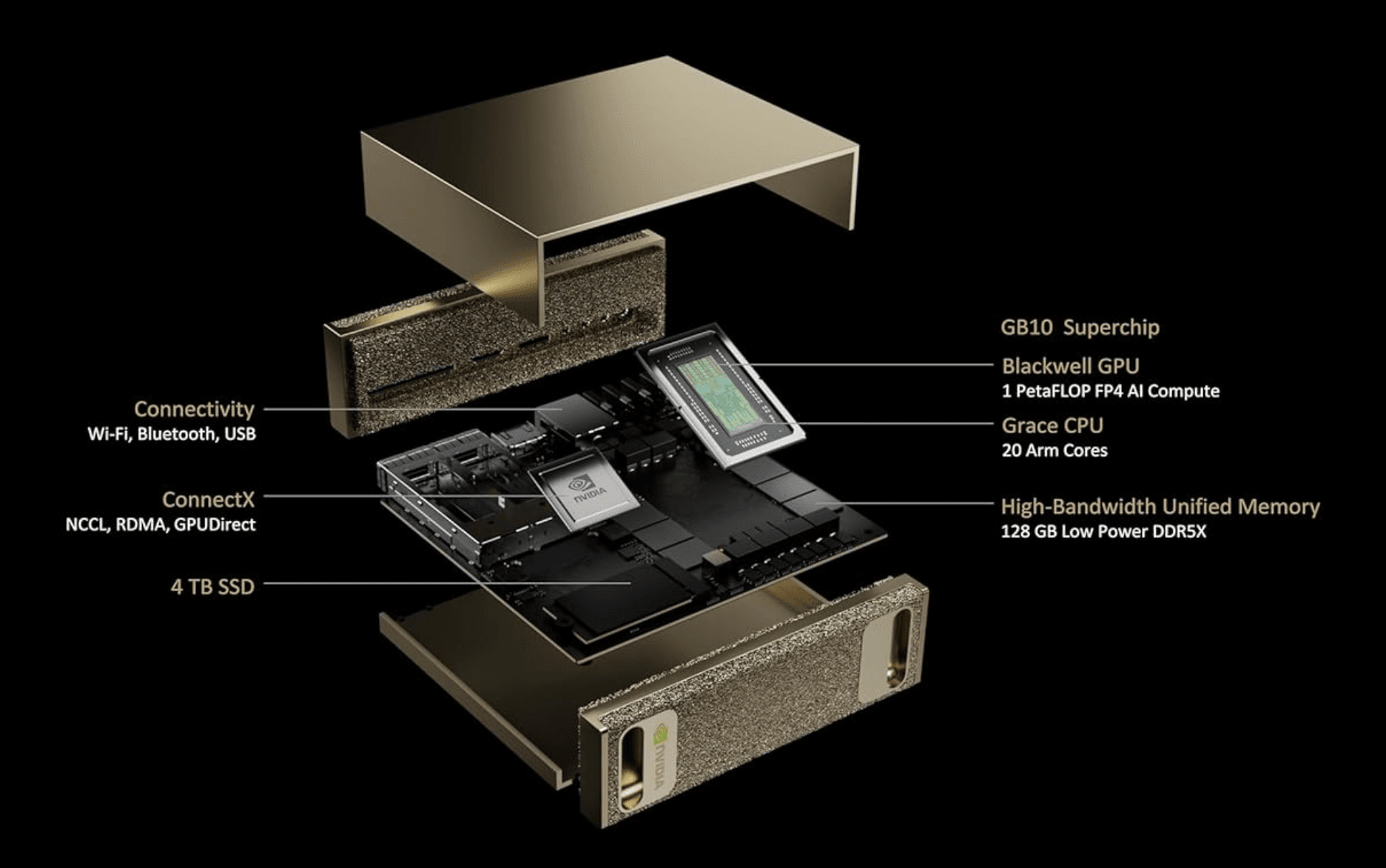
Depending on the workload, small businesses can start with consumer hardware: a capable desktop, a Mac with enough memory, a gaming GPU, a small local server, or a dedicated workstation. Tools like Ollama, LM Studio, AnythingLLM, and local retrieval systems have made the setup far more approachable than it was even a year or two ago.
This does not make infrastructure free. Local AI still has costs: hardware, electricity, maintenance, model management, backups, and troubleshooting. But those costs are more predictable than pure per-token scaling, and the business gains more control over where work runs.
Why This Matters For SMBs
For a small business, the goal is not to win a benchmark. The goal is to make AI useful without creating a runaway bill or a fragile dependency.
Open source models help SMBs:
- control recurring AI costs,
- keep sensitive workflows closer to the business,
- build repeatable internal automations,
- reduce vendor lock-in,
- experiment without worrying about every token,
- and reserve frontier AI spend for the moments where it actually matters.
This is not anti-OpenAI, anti-Anthropic, or anti-cloud. I still use frontier AI heavily. The key is using it intentionally.
The Real Takeaway
The future of SMB AI is hybrid.
Closed frontier models will continue to be important for the hardest reasoning, coding, synthesis, and strategy work. Open source models will become the operating layer for repeatable workflows, internal knowledge, automation, and cost-controlled daily usage.
The businesses that understand this early will not just “use AI.” They will build AI operating systems around their own processes.
My current rule of thumb is simple:
Local AI is the workbench. Frontier AI is the boardroom.
Use both. Route intelligently. Capture what works. Then let the repeatable parts run closer to home.
If you are a small business owner trying to figure out whether open source AI models make sense for your workflow, the best starting point is not buying hardware. It is mapping your repeated AI tasks, identifying what must stay private, and deciding which workflows are worth turning into durable processes.