PLA vs PETG vs ABS: What to Use and When
Choosing the right filament is one of the biggest decisions for any 3D printer owner. PLA, PETG, and ABS are the three most common materials, each with distinct strengths and weaknesses. Pick wrong and you’ll waste filament on failed prints. Pick right and your prints will be stronger, cleaner, and more reliable.
This guide breaks down when to use each material so you stop guessing and start printing with confidence.
Quick Comparison
| Property | PLA | PETG | ABS |
| Ease of printing | PLA ★★★★★ (easiest) | PETG ★★★☆☆ (moderate) | ABS ★★☆☆☆ (hardest) |
| Strength & durability | Moderate | High | High |
| Heat resistance | Low (~50°C) | Moderate (~75°C) | High (~95°C) |
| Flexibility | Brittle | Slightly flexible | Moderate |
| Odor during printing | Minimal (sweet) | Mild | Strong, noxious fumes |
| Ventilation needed | No | Recommended | Required |
| Best for | Displays, prototypes, low-stress parts | Functional parts, outdoor use, enclosures | Automotive, mechanical parts, high-heat environments |
| Post-processing | Easy (sanding, painting) | Moderate (needs acetone or sanding) | Difficult (acetone vapor smoothing) |
Best for Beginners: PLA
PLA is the default material for a reason. It prints reliably on virtually any 3D printer, needs no enclosure, warps minimally, and comes in an enormous range of colors and finishes.
When to use PLA:
– Prototypes and proof-of-concept prints
– Decorative items, cosplay props, and display pieces
– Jigs, fixtures, and workshop tools that don’t see heat
– Educational prints and learning exercises
When to avoid PLA:
– Parts that will see heat (car dashboards, outdoor summer use) — PLA deforms at ~50°C
– Mechanical parts under stress (gears, clips, load-bearing brackets)
– Anything that will be left in direct sunlight for extended periods
Recommended PLA types:
– Standard PLA — general-purpose printing
– PLA+ — tougher, slightly more flexible for functional parts
– Silk PLA — aesthetic prints with a glossy, metallic finish
Best All-Rounder: PETG
PETG bridges the gap between PLA’s ease of printing and ABS’s strength. It prints well on both enclosed and open-frame printers, handles moderate heat, and resists moisture and chemicals better than PLA.
When to use PETG:
– Outdoor projects exposed to weather
– Mechanical parts that need durability (phone mounts, enclosures, brackets)
– Anything that will see warmth but not extreme heat (~75°C)
– Parts that need some flexibility without breaking
When to avoid PETG:
– High-detail miniatures (stringing is common and hard to control)
– Food-safe applications (most PETG is not FDA-approved)
– Ultra-smooth cosmetic finishes (PETG tends to show layer lines more than PLA)
Recommended PETG types:
– Standard PETG — functional parts, outdoor use
– PETG Pro — higher strength and layer adhesion for demanding applications
– Chameleon/Color-shift PETG — aesthetic prints that change color in different light
Best for High-Heat & Mechanical Parts: ABS
ABS is the heavyweight champion of strength and heat resistance. It handles temperatures up to ~95°C, resists chemicals, and can be smooth-finished with acetone vapor for a factory-quality surface.
When to use ABS:
– Automotive parts and engine bay components
– Electrical enclosures and junction boxes
– Mechanical gears, brackets, and functional hardware
– Parts that need acetone vapor smoothing for a clean finish
When to avoid ABS:
– Bedroom or garage printing without ventilation (releases styrene fumes)
– First-time printing (warping and cracking are common for beginners)
– Outdoor UV exposure (ABS degrades in sunlight unless UV-inhibited)
Recommended ABS types:
– Standard ABS — general functional printing
– ABS Pro — improved strength and layer adhesion
– Matte ABS — reduces visible stringing and layer lines
Buyer Warnings
PLA is biodegradable — but only in industrial composting facilities. Don’t leave PLA prints in a hot car. They will deform.
PETG strings badly. Use retraction settings and lower print speeds. A filament dryer helps significantly.
ABS requires ventilation. It releases styrene fumes that are harmful in enclosed spaces. Never print ABS in a bedroom or unventilated room.
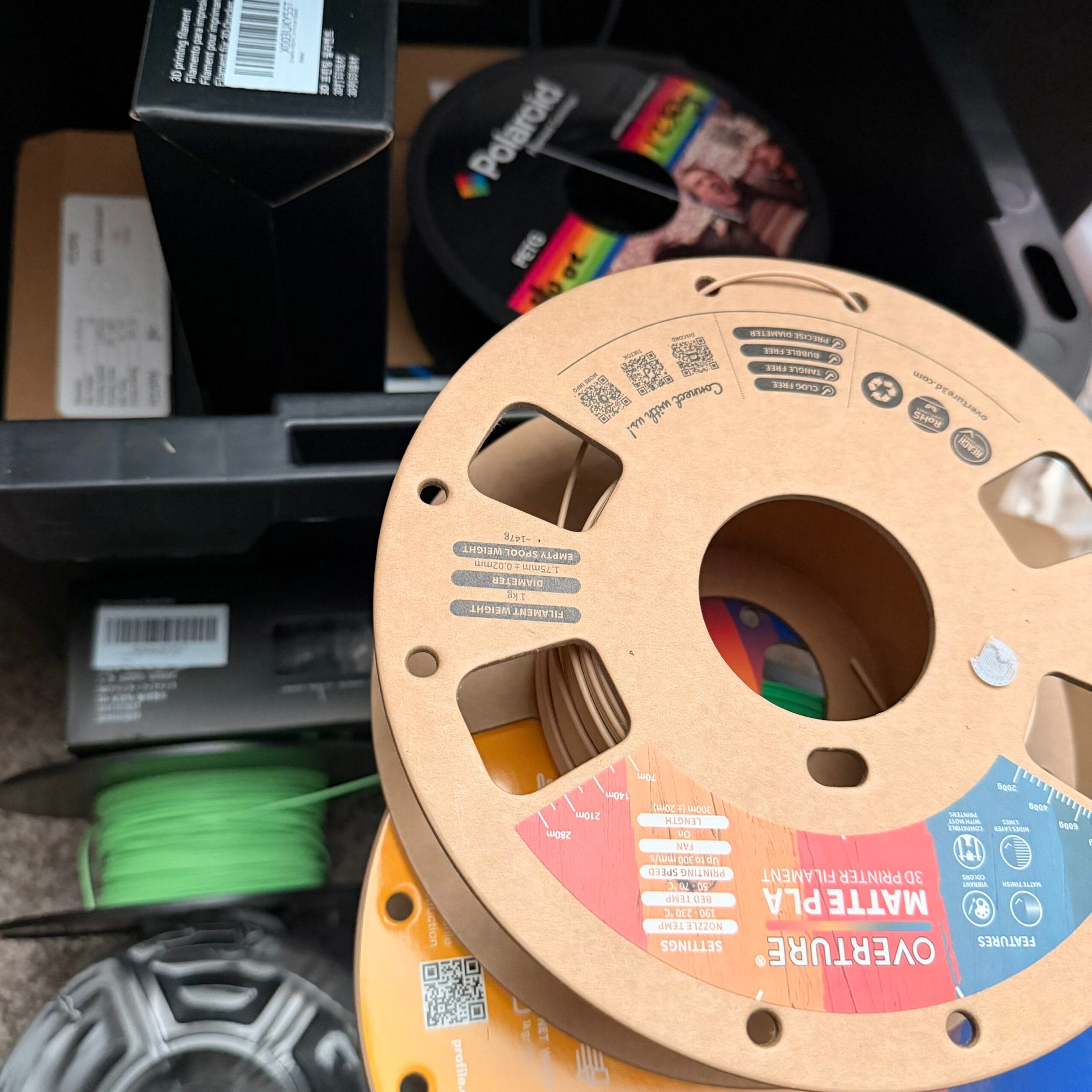
Filament longevity matters. All three materials absorb moisture from the air. Moist filament causes stringing, bubbling, weak layers, and failed prints. Store filament in airtight containers with desiccant.
Color matters for heat absorption. Black filaments absorb more UV and degrade faster outdoors. For outdoor use, choose UV-stabilized PETG or ABS with UV inhibitor.
The Bottom Line
– Start with PLA if you’re learning or printing decorative items.
– Switch to PETG when you need durability, heat resistance, or outdoor use.
– Choose ABS for high-heat mechanical parts — but only with proper ventilation.
No single material does everything. The key is matching the material to the job.
> Need the right filament for your project? RIOWARE’s Material Picks curates PLA, PETG, and ABS filaments from trusted brands — all with live Amazon pricing and verified compatibility.
As an Amazon Associate, we earn from qualifying purchases. Material recommendations are based on verified reviews and real-world testing, not sponsorships.